By AndrewWiebe, 18 December, 2025
English
Body

Historical Context

Gay American Indians (GAI) was founded in San Francisco in 1975 by Randy Burns (Northern Paiute) and Barbara May Cameron (Hunkpapa Lakota). The origin stories can be found in Cherokee/Chickasaw scholar Brian Joseph Gilley (2006) and settler scholar Will Roscoe (2020). It is widely recognized as the first organization in North America specifically for gay Native Americans / Indigenous LGBTQ+ people, emerging at the intersection of the Red Power movement and the gay liberation movement, as described by settler scholar Gregory Smithers (2022) in Ms. Magazine, the Alameda Native History Project. Early meetings were held in Bay Area Native community spaces (like the American Indian Center) and apartments in the Mission and Castro, functioning as both a support group and a political home for Native LGBTQ+ people in the city. Maps of this early activism with multi-media can be found on Historypin. 

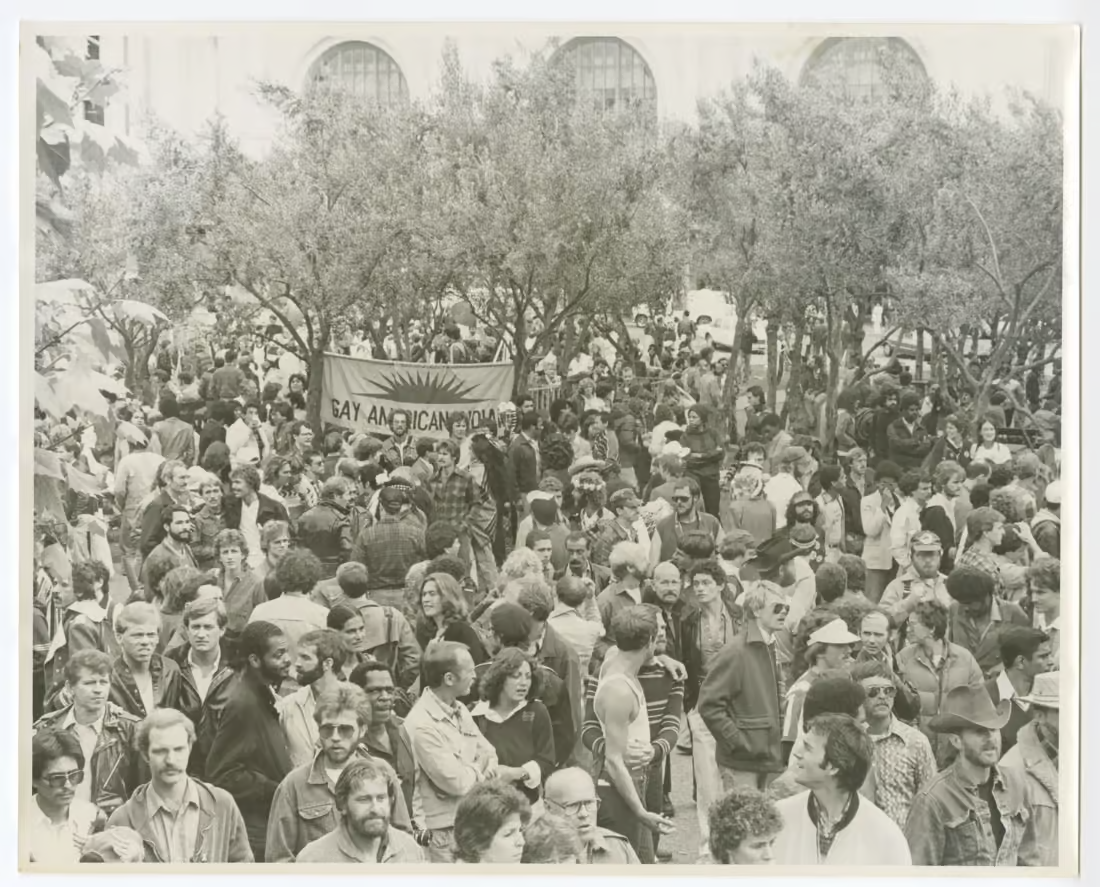
Initially a social circle, GAI soon engaged in public activism and visibility work. By the late 1970s, they were marching as a named contingent in San Francisco’s Gay Freedom Day/Gay Pride parades, carrying banners that made Native presence visible in queer public space, which can be seen in the GLBT Historical Society archival images.

1. AIDS activism
With the onset of the AIDS epidemic, GAI members recognized that existing services often did not reach Native people in the Bay Area. They helped found the Indian AIDS Project and the American Indian AIDS Institution, organizations aimed at providing culturally specific information and support for Native people living with HIV/AIDS. Co-founder Randy Burns later noted that dozens of GAI members—82 reported in the Bay Area Reporter—died of AIDS-related complications, underlining how central this work became to the group’s mission.

2. Changing language: from “berdache” to “Two-Spirit”
GAI was pivotal in challenging anthropological use of the term “berdache,” which many Native people rejected as a colonial slur. Members advocated for terminology rooted in Indigenous self-determination. After the term “Two-Spirit” was coined in 1990 at a Native LGBTQ gathering in Winnipeg, GAI helped promote it as a pan-Indigenous umbrella term to replace “berdache” in both community and scholarly contexts. This is discussed with a full history of the organizations that pushed for this shift by Queer settler socio-linguist, Nicholas Lo Vecchio (2022).

At the 1992 American Anthropological Association meeting, GAI members met with anthropologists to push for a formal shift away from “berdache.” Subsequently, major scholars of gender and sexuality in Native communities increasingly adopted “Two-Spirit” and acknowledged GAI’s role in that change.

3. Publishing and storytelling
In the 1980s, GAI collaborated with scholar and activist Will Roscoe to produce Living the Spirit: A Gay American Indian Anthology (1988), one of the earliest published collections centering Native LGBTQ+/Two-Spirit voices. The anthology gathered essays, poems, history, and testimony by Native writers, and remains a key reference in queer Indigenous and Two-Spirit studies and can be further contextualized with archival fonds at the University of California. 

GAI also produced newsletters, flyers, bibliographies, and educational materials, distributing them throughout Native and LGBTQ+ networks. These materials helped other Indigenous groups across the continent form organizations such as American Indian Gays and Lesbians (Minneapolis), Gays and Lesbians of the First Nations (Toronto), WeWah and BarCheeAmpe (New York City), and Nichiwakan (Winnipeg).

Photo from June 24, 1979; Gay American Indians banner at Civic Center during San Francisco “Gay Freedom Day Parade”. Photo by Joe Altman.


Location
Media Location
The GLBT Historical Society of San Francisco
Resource Provenance
The GLBT Historical Society of San Francisco
Will Roscoe
Nicholas Lo Vecchio
GAI
Alameda Native History Project
Gregory Smithers
Brian Joseph Gilley
GLBT Historical Society

Regeneration Notes