July 16, 1832 – A Colonial “Chief” Is Made
On July 16, 1832, during a U.S. expedition to the headwaters of the Mississippi, Indian agent Henry Rowe Schoolcraft gathered an Ojibwe council near present-day Cass Lake. With no hereditary ogimaa (civil leader) present, he placed a silver medal around Ozaawindib’s neck. He declared her a “chief” so that the United States would have a recognizable figure to deal with. This act did not come from Ojibwe political protocols but from U.S. colonial practice: the invention or elevation of “chiefs” to simplify negotiations and consolidate control. Ozaawindib’s story reminds us that even moments that appear to honour Indigenous leaders can also reveal how colonial power tried to reshape Native governance and gender on its own terms.
Mention in The Narrative of John Tanner (1830)
In The Narrative of the Captivity and Adventures of John Tanner (1830), Tanner describes meeting Ozaw-wen-dib, (Yellow Head or Brown Head), an Ojibwe person he identifies as A-go-kw, a term referring to individuals assigned male at birth who lived as women and were recognized as such within their communities. Tanner notes that Yellow Head was skilled in women’s work, had lived with several husbands, and later married the chief Wa-ge-tote. pp. 106–108.
He says that the winter around 1800, while hunting in the Red River country (p 94) near the future settlement of Pembina, John Tanner records a visit from Ozaw-wen-dib , an Ojibwe agokwa from Leech Lake who, as Tanner writes, “made [herself] a woman” and was “called [a] woman by the Indians” (p 105).
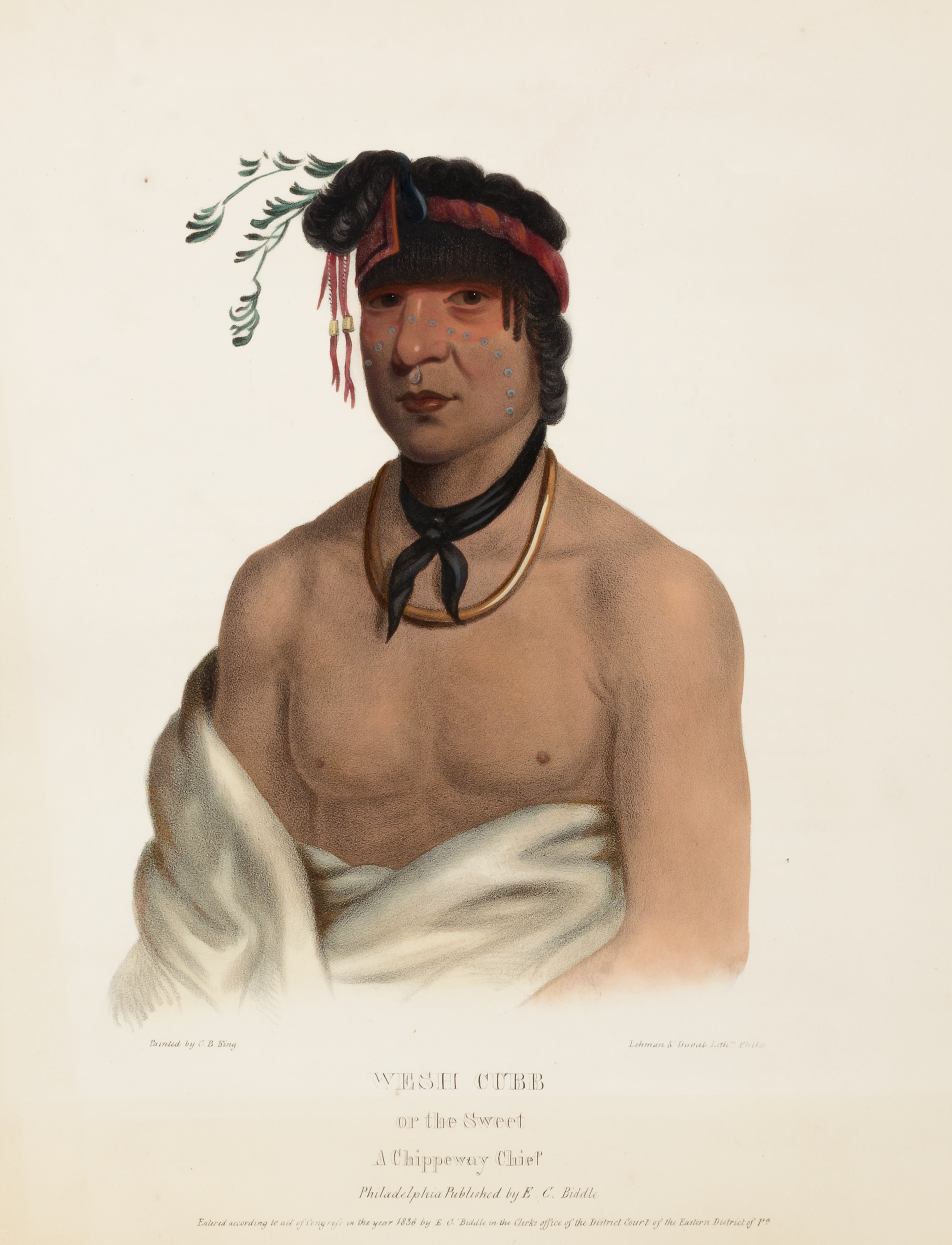
Artwork Info, depicting Ozaawindib's brother or step-brother, Wesh-Cubb
Charles Bird King, WESH-CUBB. A CHIPPEWAY CHIEF., From History of the Indian Tribes of North America, ca. 1836, hand-colored lithograph on paper, sheet: 20 1⁄8 x 14 1⁄8 in. (51.2 x 35.9 cm), Smithsonian American Art Museum, Museum purchase, 1985.66.153,255.2
Possibly painted by James Otto Lewis at the Prairie du Chien treaty council in 1825
Free to Use
Related Images
Title in Traditional Language
Ozaawindib
Anishinaabemowin
Body
Location
Media Location
Smithsonian American Art Museum
URL to resource or citation
Regeneration Notes